Vstup zadarmo
There is a point of no return. We must reach it!
FRANZ KAFKA
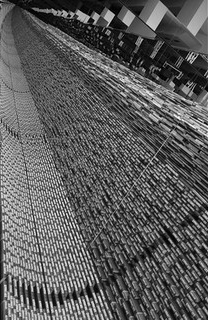
Things and events do not gain significance when they occur, but only when they are experienced as images. Only the image grants true existence to being. For something to become real, it must first be shaped by an idea of reality, an interpretation of the world. Images and texts are so important to us that even the original piece must submit to its reproduction. IMPLUVIUM is a parable of such a transformation. It is a metaphorical reservoir filled with symbolic elements, serving as a medium for thoughts, feelings, legends, myths, and history, from which true reality emerges—an image of our world and ourselves.
Matej Krén
THE BOOK DWELLINGS OF MATEJ KRÉN
Matej Krén's work is notable for its remarkable range of creativity. He captures the attention of experts and the wider public with his distinctive approach to sculpture, objects, installations, drawing, graphic art, painting, performance art, film, music, sound, and words. His works address contemporary art issues, such as the breakdown of boundaries between reality and fiction, current events and history, while also exploring classic artistic themes – surface and space, interior and exterior, part and whole. His work is characterised by a quest for complex content expressed in clear and concise language.
His work with books – "book dwellings" – has probably made the most significant impression on the wider public. They are typical for their peculiar tension between illusion and reality, between the physical and virtual worlds, between the present place and abstract space. One of his first book works was called IDIOM, a tall column made from thousands of books, which was first exhibited at the Biennial of Contemporary Art in São Paulo, Brazil, in 1994. An opening in the object's wall provided a glimpse into its other dimensions. The column's interior broke the solid anchoring in space and opened into a suggestive tunnel formed from "book texts" – a kind of informational version of the original idea of the axis of the world, axis mundi. In the GRAVITY MIXER project for Expo 2000 in Hanover, the static structure of a rotunda made of books was transformed into a labyrinthine network of corridors via a set of rotating mirrors. The visitor thus became part of the work, blurring the line between reality and fiction. The presence of the visitor is also essential for the work PASSAGE (permanently located in the Bratislava City Gallery since 2004). In a moment, they move between two spaces – the real and the illusory- and, simultaneously, between two opposing worlds – the world of real existence and its "metaphysical" image in the texts of books. In 2006, the BOOK CELL project was created for the Museum of Modern Art in Lisbon to mark the 50th anniversary of the Calouste Gulbenkian Foundation, which remains a key pillar of support for science, art, and culture in Portugal. A hexagonal "cell" composed of books symbolised the foundation's key relationship to books and book culture. On the occasion of the opening of the DOX Centre for Contemporary Art in Prague in 2008, Matej Krén prepared a monumental installation entitled SEDIMENT. The giant curved wall of books has connected two realities – the objective and the symbolic – through the gradual sedimentation of the world in texts, texts in books, and books in the work itself. The piece could be perceived as a barrier to physical movement, while also functioning as a communication interface that ignores the limits of time and space. The SCANNER project, created at the Museum of Modern Art in Bologna in 2010, introduced visitors to a rather unusual situation. They became participants in the transition of "data" between the real world and its literary representation. In a twelve-metre-long structure, a cylindrical container made of books was transformed into another "aggregate" through a light-scanning process – into fluorescent radiation captured in the paper memory of the books.
In Matej Krén's work, the space of symbolic interpretation of the world overlaps with the lived space of human existence, evoking an ambiguous interstice between realities. Working with books, "book dwellings," is the architecture of this intermediate space; they are structures in which the walls, created by layering books, do not obscure our view, but rather deepen and clarify it...
Egon Alter
Curator:
PhDr. Ivan Jančár
Date from:
13.11.2025
Date to:
13.11.2027
Location:
Foyer of the new SND building garage


